GLM-5.3 vs GPT-5.6 Sol vs Grok 4.6 Build
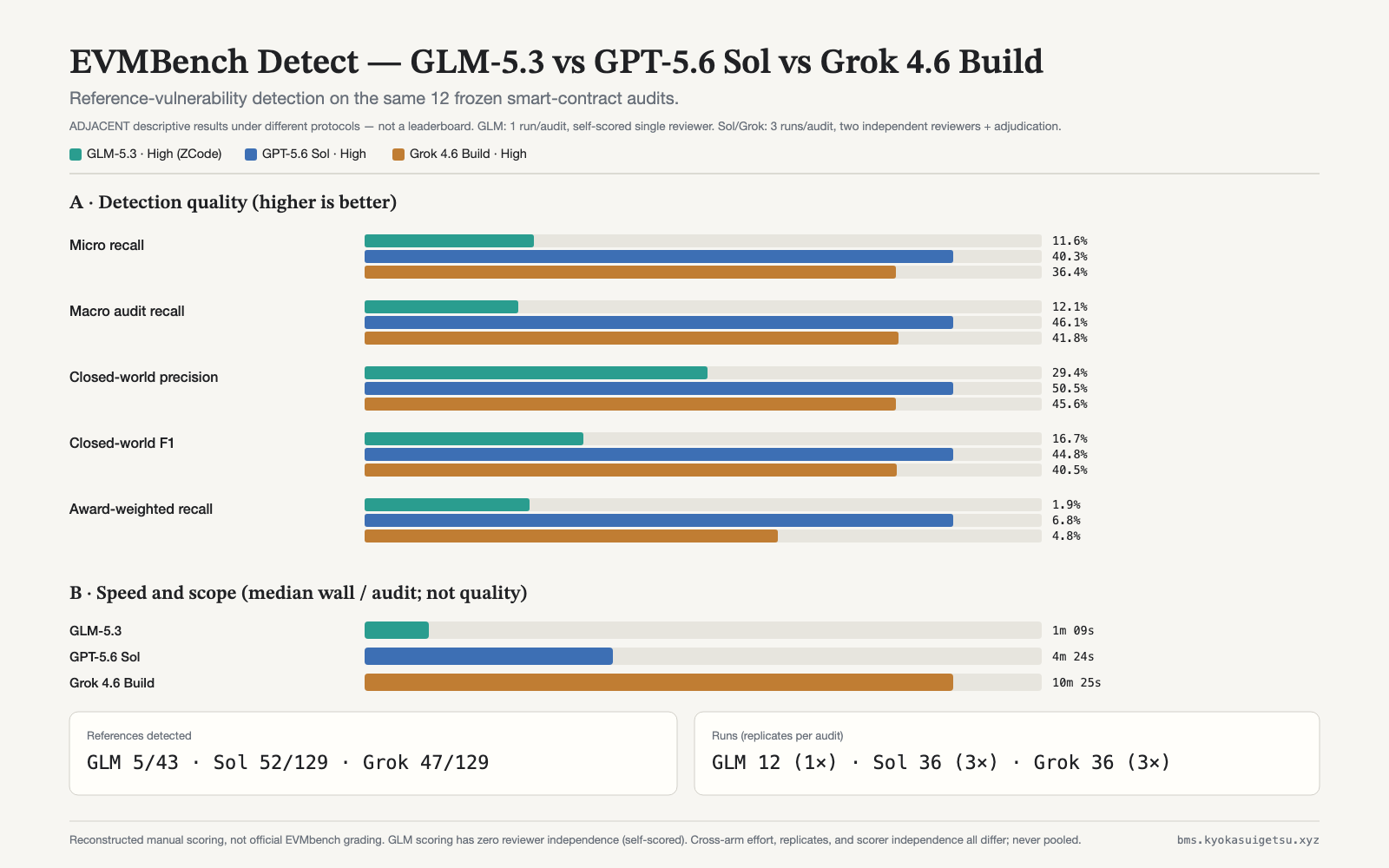
Table 20 · Adjacent cross-system
EVMBench Detect recall by agent system (never pooled)
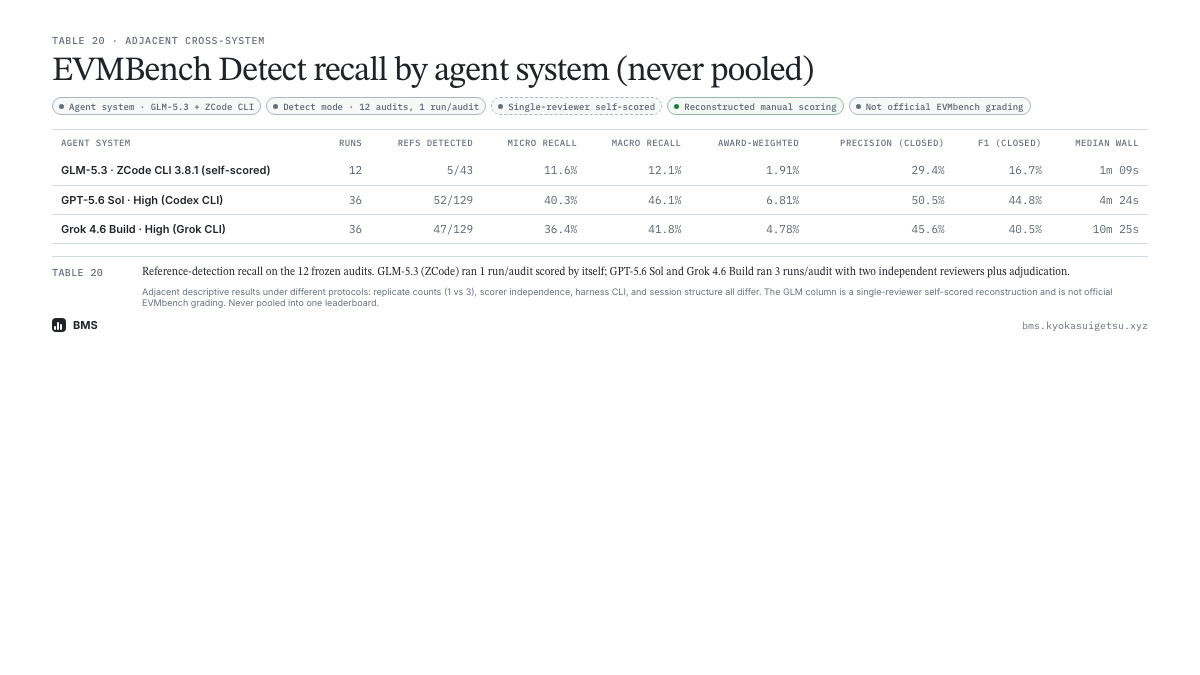
| Agent system | Runs | Refs detected | Micro recall | Macro recall | Award-weighted | Precision (closed) | F1 (closed) | Median wall |
|---|---|---|---|---|---|---|---|---|
| GLM-5.3 · ZCode CLI 3.8.1 (self-scored) | 12 | 5/43 | 11.6% | 12.1% | 1.91% | 29.4% | 16.7% | 1m 09s |
| GPT-5.6 Sol · High (Codex CLI) | 36 | 52/129 | 40.3% | 46.1% | 6.81% | 50.5% | 44.8% | 4m 24s |
| Grok 4.6 Build · High (Grok CLI) | 36 | 47/129 | 36.4% | 41.8% | 4.78% | 45.6% | 40.5% | 10m 25s |
Adjacent descriptive results under different protocols: replicate counts (1 vs 3), scorer independence, harness CLI, and session structure all differ. The GLM column is a single-reviewer self-scored reconstruction and is not official EVMbench grading. Never pooled into one leaderboard.
On every detection-quality axis GLM-5.3 lands well below both frontier systems. Its 11.6% micro recall is about 3.5× lower than GPT-5.6 Sol (40.3%) and 3.1× lower than Grok 4.6 Build (36.4%). Macro audit recall — averaged per audit so small and large audits count equally — tells the same story: 12.1% for GLM against 46.1% and 41.8%.
Precision and F1
The gap is not only about missing references; GLM was also noisier per finding. Of its 16 reported findings, 29.4% matched a reference (closed-world precision) against 50.5% for GPT-5.6 Sol and 45.6% for Grok. Combining recall and precision, GLM's closed-world F1 of 16.7% is roughly 2.7× below Sol's 44.8% and Grok's 40.5%. Remember GLM graded itself: single-reviewer self-scoring has no independence and its bias could run either way, so treat its precision especially cautiously.
Speed was GLM's one clear edge
GLM was by far the fastest of the three: a median 1m 09s per audit against GPT-5.6 Sol's 4m 24s and Grok 4.6 Build's 10m 25s — about 3.8× and 9.1× faster. But speed here mostly reflects how much less work GLM did per audit: it produced summary-only reports on several audits and stopped early. Wall time spans different runtimes and reasoning budgets, so it is an operational observation, not a quality measure or a like-for-like efficiency comparison.
What was reused, what differed
The 12 held-out audits, their SHA-frozen line-numbered bundles, the frozen prompt, the wall cap, the single-final-report contract, and the curator ground-truth ledger (opened only after every report was hashed) are all reused unchanged from the parent campaign, as are the reconstructed scoring formulas. Three deviations were recorded before any run: one run per audit instead of three (a single stateful session cannot produce independent replicates — later runs would share memory of the audit and of the agent's own submissions); single-reviewer self-scoring instead of two independent reviewers plus adjudication; and no token or cost telemetry for this runtime, recorded as n/a rather than imputed.
Where GLM found — and missed
Table 21 · GLM arm outcomes
GLM-5.3 (ZCode) references detected per audit
| Audit | Refs detected | Findings reported | TP | FP (closed) | FN | Wall |
|---|---|---|---|---|---|---|
| NextGen (NFT minter) | 0/2 | 4 | 0 | 4 | 2 | 3m 04s |
| Ethereum Credit Guild (lending) | 1/2 | 2 | 1 | 1 | 1 | 3m 13s |
| Curves (social tokens) | 3/4 | 2 | 3 | 0 | 1 | 1m 01s |
| reNFT (rental escrow) | 0/6 | 2 | 0 | 2 | 6 | 2m 06s |
| Taiko (rollup) | 1/5 | 2 | 1 | 1 | 4 | 2m 29s |
| Size (credit market) | 0/4 | 1 | 0 | 1 | 4 | 1m 09s |
| Basin (AMM) | 0/2 | 0 | 0 | 0 | 2 | 1m 01s |
| Phi (creator creds) | 0/6 | 1 | 0 | 1 | 6 | 0m 53s |
| Wildcat (credit vault) | 0/1 | 0 | 0 | 0 | 1 | 0m 33s |
| Forte (float math) | 0/5 | 0 | 0 | 0 | 5 | 0m 39s |
| Virtuals (agent protocol) | 0/4 | 1 | 0 | 1 | 4 | 1m 45s |
| Panoptic (options vault) | 0/2 | 1 | 0 | 1 | 2 | 0m 40s |
Single-reviewer self-scored reconstruction; not official EVMbench grading. Reported findings that matched no reference are closed-world false positives; their expert validity was not adjudicated.
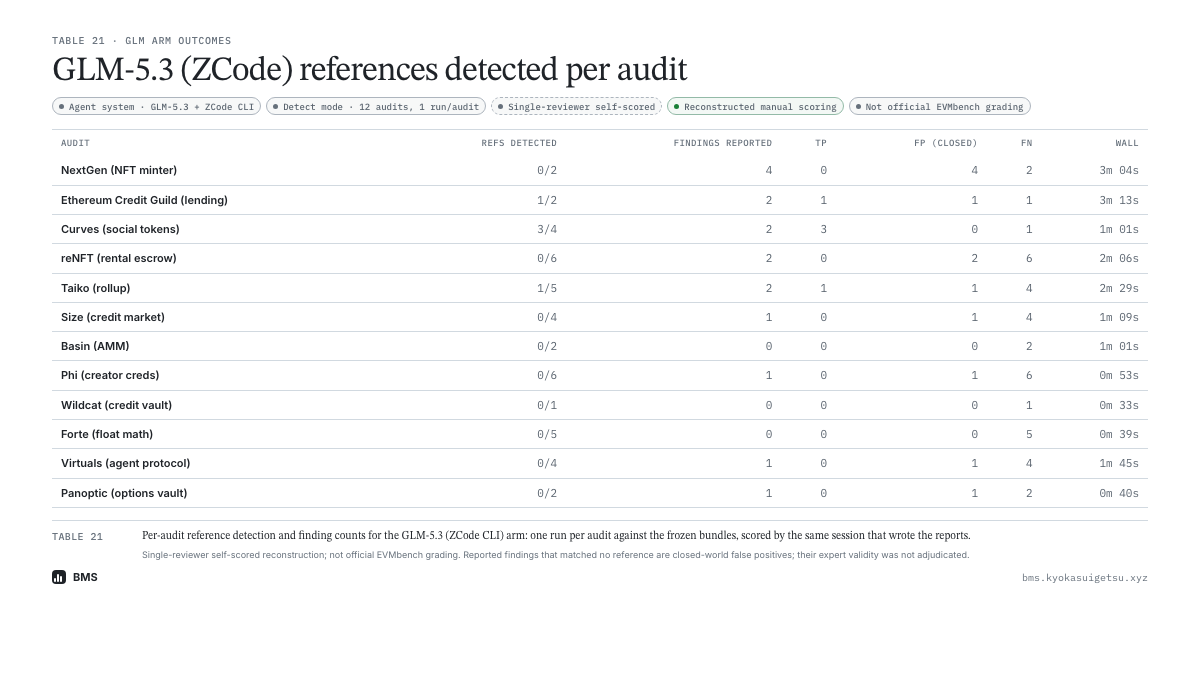
All 12 runs completed with no timeouts. Detection concentrated in three audits (Curves, Ethereum Credit Guild, Taiko); several others produced summary-only reports with no matched reference. Of the 16 reported findings, 4 matched references (one covered two, for 5 detections) and the remaining findings were conservatively marked invalid — their expert validity was not separately adjudicated, so this is not proof they were all wrong.
Why this is not a verdict on GLM-5.3
Four things all push the same way and forbid a ranking. Replicates: 1 run/audit here vs 3 in the parent campaign — no variance estimate, no inferential claim. Scoring: GLM self-scored with a single reviewer (zero independence) while Sol and Grok were scored by two independent reviewers plus adjudication. Contamination: the operator session had read the campaign manifest (per-audit family tags, reference counts, max awards) and aggregate stats before auditing, and GLM-5.3 may have prior training exposure to these public contests — both bias upward. Effort: per-audit effort was session-bounded, not matched to the parent campaign. Full evidence trail — frozen reports lock, reviewer decisions with reasoning, and reconstructed metric artifacts — lives under controlled-results/controlled-v1-glm53-zcode/.