What happened
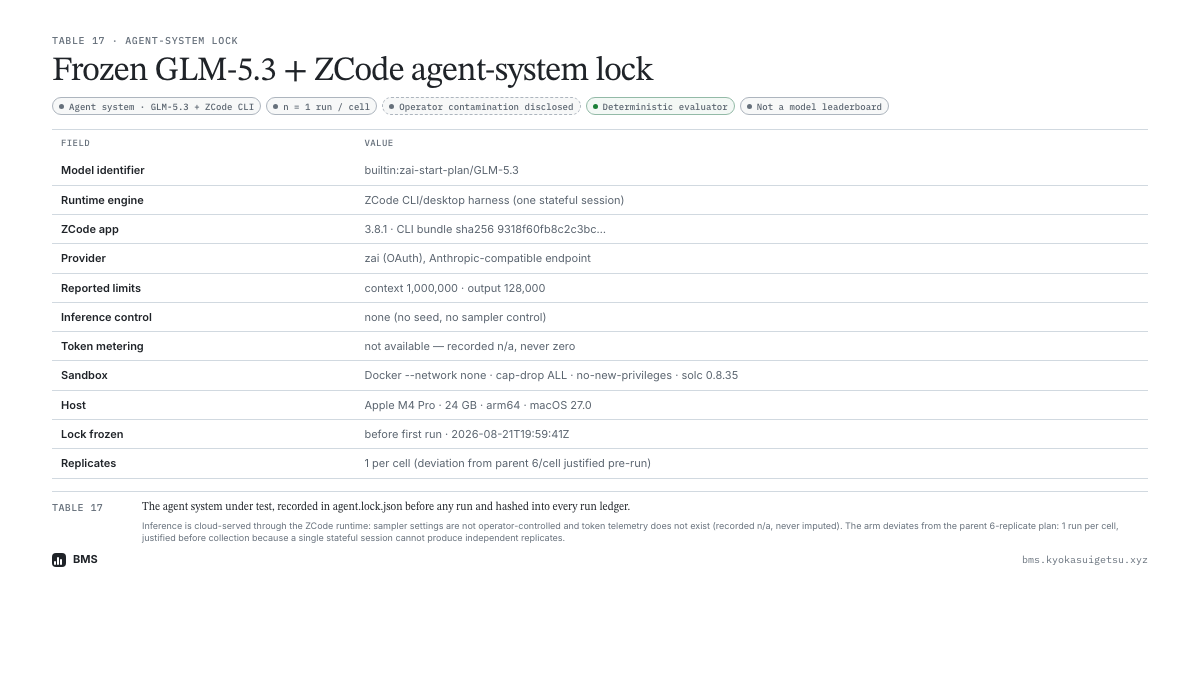
Across the same three curated fixtures and the same frozen evaluator as the local pilot, every GLM-5.3 run submitted one self-contained Foundry regression test that compiled on both revisions, failed on the vulnerable revision, and passed on the curator-held fixed revision — in all three conditions: tool-assisted, static (no tools), and budgeted triage. The only in-run defect appeared in the first run, where a first submission with malformed try-call syntax failed forge build and was repaired from the compiler error inside the same run — exactly the feedback loop the tool-assisted condition exists to measure.
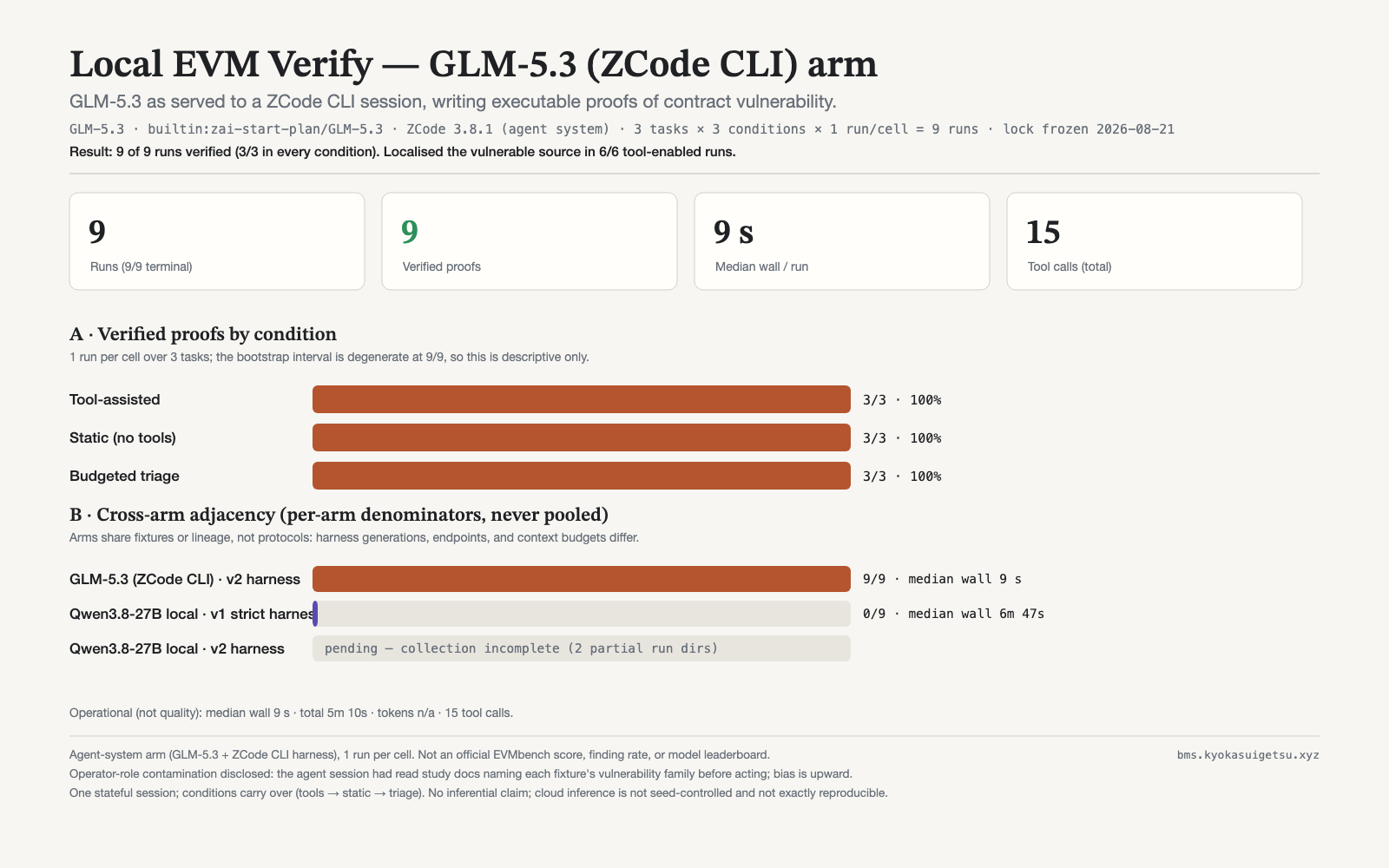
Table 14 · GLM-5.3 verified proofs
GLM-5.3 (ZCode) verified proofs per task and condition
| Task (family) | Tool-assisted | Static (no tools) | Budgeted triage |
|---|---|---|---|
| share-inflation (asset/share rounding) | 1/1 | 1/1 | 1/1 |
| reentrancy-withdraw (external-call ordering) | 1/1 | 1/1 | 1/1 |
| uninitialized-treasury (initialization authorization) | 1/1 | 1/1 | 1/1 |
Agent-system arm (GLM-5.3 + ZCode harness), n = 1 run per cell, same fixtures and frozen evaluator as the local pilot; operator-role contamination is disclosed in the report. Cells with no terminal run read "pending", never zero. Not an official EVMbench score.
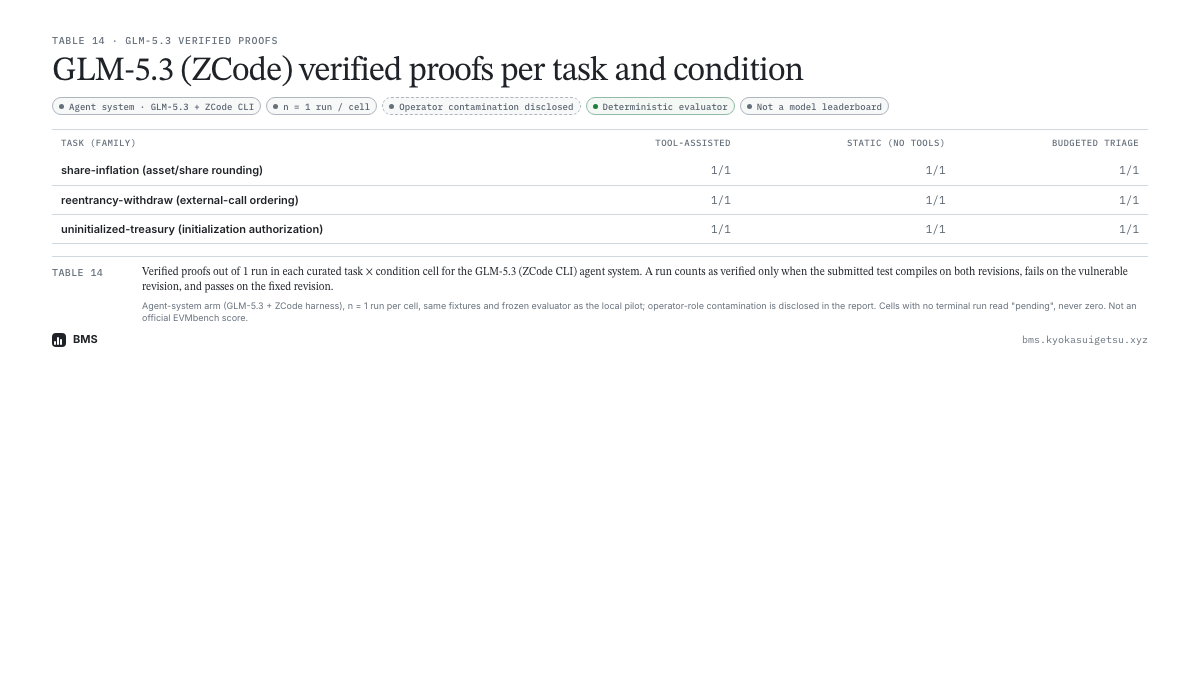
Table 15 · GLM-5.3 verified-proof rate
GLM-5.3 (ZCode) verified-proof rate by condition
| Condition | Agent access | Terminal | Verified | Rate | 95% CI |
|---|---|---|---|---|---|
| Tool-assisted | Bounded search/read + forge build/test feedback, then one submitted proof | 3 | 3/3 | 100% | 100–100% |
| Static (no tools) | Full source context (target + provided test harness); no tool feedback | 3 | 3/3 | 100% | 100–100% |
| Budgeted triage | A strict budget of four inspect operations, then one submission | 3 | 3/3 | 100% | 100–100% |
The interval is degenerate at 9/9 and n is 1 per cell: this is a descriptive result only, with no inferential claim. Condition-level contrasts are confounded by within-session carryover (tools ran before static and triage).
The agent system, frozen before any run
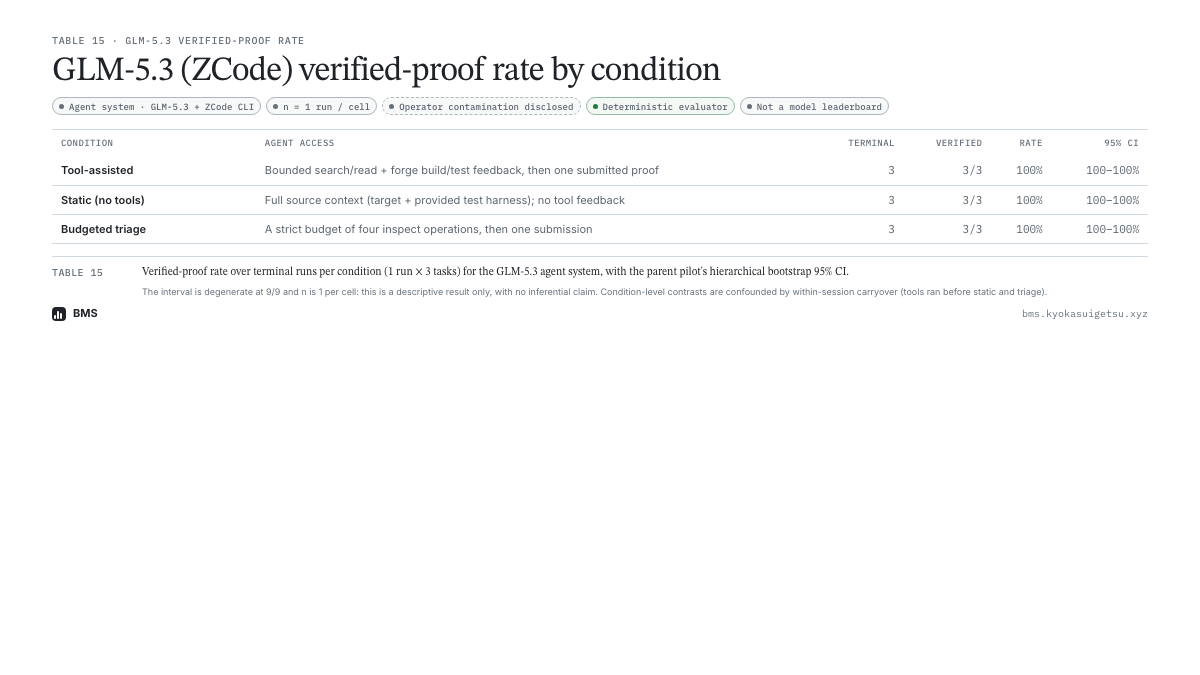
The arm replaces the pilot's local Ollama loop with an explicit turn-taking driver: the ZCode session is the agent, submitting one JSON action per turn under the parent's unchanged action policy and evaluator. Inference is cloud-served GLM-5.3 through the ZCode runtime — sampler settings are not operator-controlled, and token telemetry does not exist for this runtime, so token columns read n/a rather than an invented number.
Table 17 · Agent-system lock
Frozen GLM-5.3 + ZCode agent-system lock
| Field | Value |
|---|---|
| Model identifier | builtin:zai-start-plan/GLM-5.3 |
| Runtime engine | ZCode CLI/desktop harness (one stateful session) |
| ZCode app | 3.8.1 · CLI bundle sha256 9318f60fb8c2c3bc… |
| Provider | zai (OAuth), Anthropic-compatible endpoint |
| Reported limits | context 1,000,000 · output 128,000 |
| Inference control | none (no seed, no sampler control) |
| Token metering | not available — recorded n/a, never zero |
| Sandbox | Docker --network none · cap-drop ALL · no-new-privileges · solc 0.8.35 |
| Host | Apple M4 Pro · 24 GB · arm64 · macOS 27.0 |
| Lock frozen | before first run · 2026-08-21T19:59:41Z |
| Replicates | 1 per cell (deviation from parent 6/cell justified pre-run) |
Inference is cloud-served through the ZCode runtime: sampler settings are not operator-controlled and token telemetry does not exist (recorded n/a, never imputed). The arm deviates from the parent 6-replicate plan: 1 run per cell, justified before collection because a single stateful session cannot produce independent replicates.
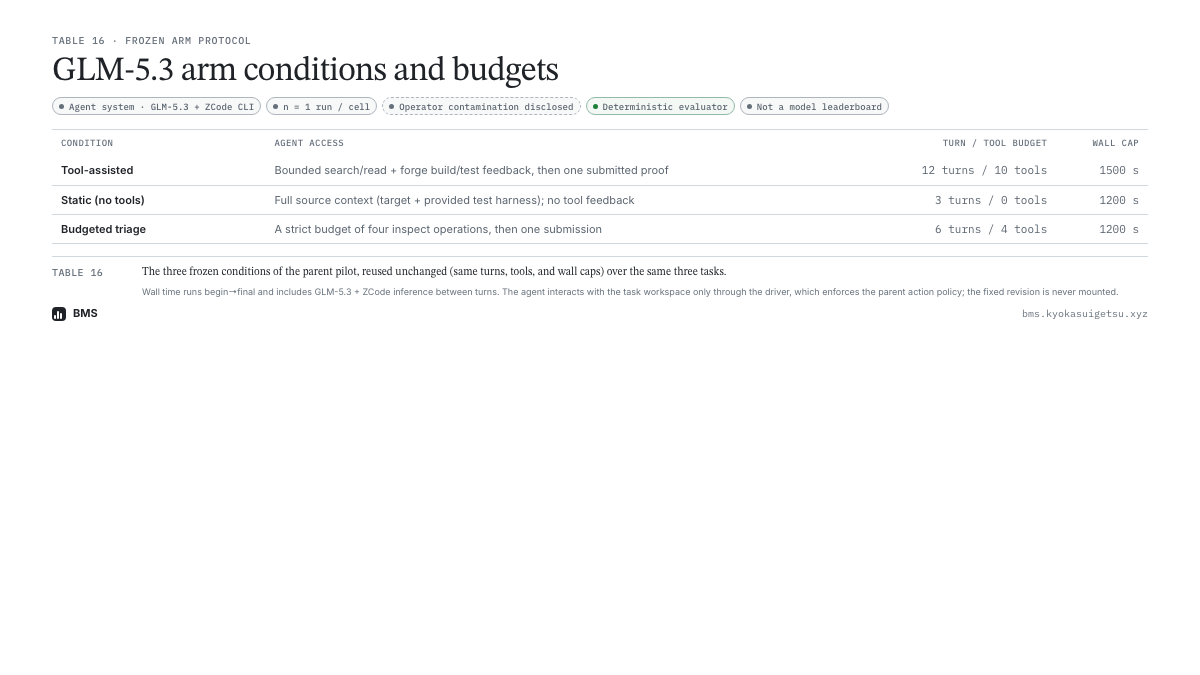
Same fixtures, same budgets, one declared deviation
The three conditions reuse the parent's frozen turn, tool, and wall budgets unchanged over the same tasks, and the fixed revisions stayed curator-held throughout. The one deviation — 1 run per cell instead of the parent plan's 6 — was recorded before collection: a single stateful agent session cannot produce independent fresh-conversation replicates, and within-session replicates would measure memory, not reproducibility.
Table 16 · Frozen arm protocol
GLM-5.3 arm conditions and budgets
| Condition | Agent access | Turn / tool budget | Wall cap |
|---|---|---|---|
| Tool-assisted | Bounded search/read + forge build/test feedback, then one submitted proof | 12 turns / 10 tools | 1500 s |
| Static (no tools) | Full source context (target + provided test harness); no tool feedback | 3 turns / 0 tools | 1200 s |
| Budgeted triage | A strict budget of four inspect operations, then one submission | 6 turns / 4 tools | 1200 s |
Wall time runs begin→final and includes GLM-5.3 + ZCode inference between turns. The agent interacts with the task workspace only through the driver, which enforces the parent action policy; the fixed revision is never mounted.
Cross-arm comparison, kept adjacent
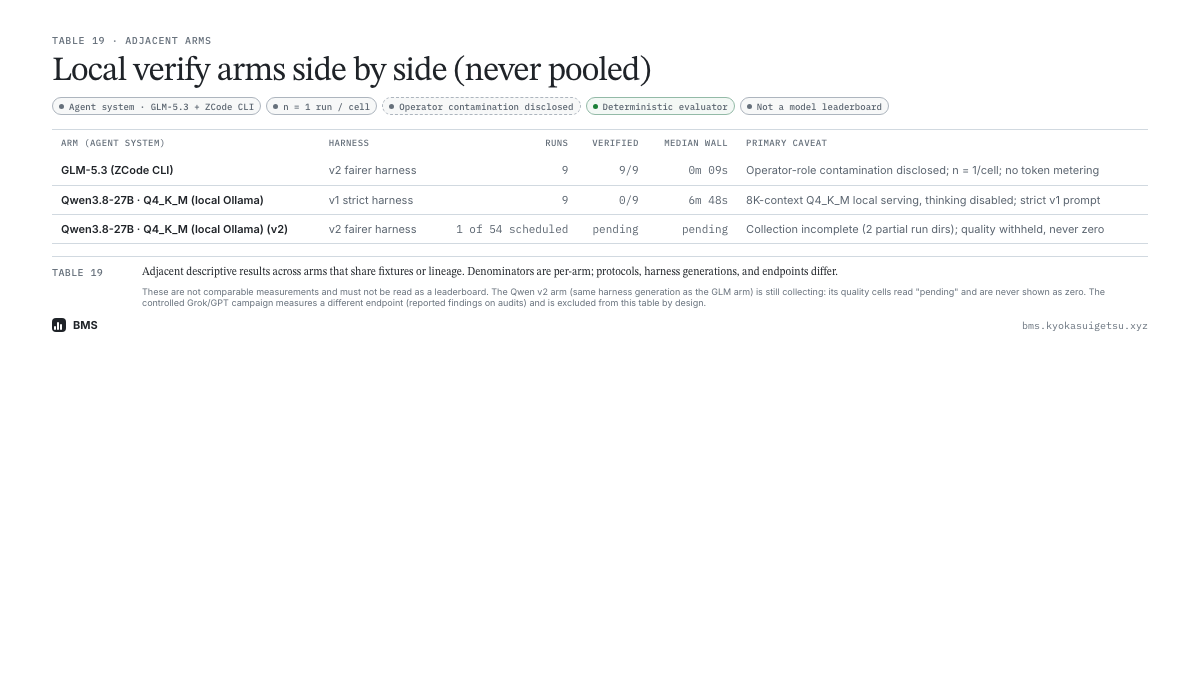
Arms in this repository share fixtures or lineage, not protocols. The Qwen v1 pilot ran a stricter harness under an 8K-context Q4_K_M local serving; the Qwen v2 deepening — the only like-for-like harness pairing for this arm — is still collecting, and its quality cells read pending. The controlled Grok/GPT campaign measures reported audit findings, a different endpoint entirely. Nothing here pools denominators into a leaderboard.
Table 19 · Adjacent arms
Local verify arms side by side (never pooled)
| Arm (agent system) | Harness | Runs | Verified | Median wall | Primary caveat |
|---|---|---|---|---|---|
| GLM-5.3 (ZCode CLI) | v2 fairer harness | 9 | 9/9 | 0m 09s | Operator-role contamination disclosed; n = 1/cell; no token metering |
| Qwen3.8-27B · Q4_K_M (local Ollama) | v1 strict harness | 9 | 0/9 | 6m 48s | 8K-context Q4_K_M local serving, thinking disabled; strict v1 prompt |
| Qwen3.8-27B · Q4_K_M (local Ollama) (v2) | v2 fairer harness | 1 of 54 scheduled | pending | pending | Collection incomplete (2 partial run dirs); quality withheld, never zero |
These are not comparable measurements and must not be read as a leaderboard. The Qwen v2 arm (same harness generation as the GLM arm) is still collecting: its quality cells read "pending" and are never shown as zero. The controlled Grok/GPT campaign measures a different endpoint (reported findings on audits) and is excluded from this table by design.
Contamination, stated plainly
The agent under test is the same session that built this arm. Before acting as agent it had read the pilot's documentation — including a table naming each fixture's vulnerability family and fix strategy — though never any fixture source, fixed revision, or golden proof. GLM-5.3 is also a coding-agent model that may have prior exposure to similar Foundry/EVM material. Both facts bias verified-proof rate upward. Conditions also ran in one session (tools, then static, then triage), so static and triage submissions benefited from syntax proven earlier in the session; condition-level contrasts are not interpretable.
Operational telemetry, kept separate from quality
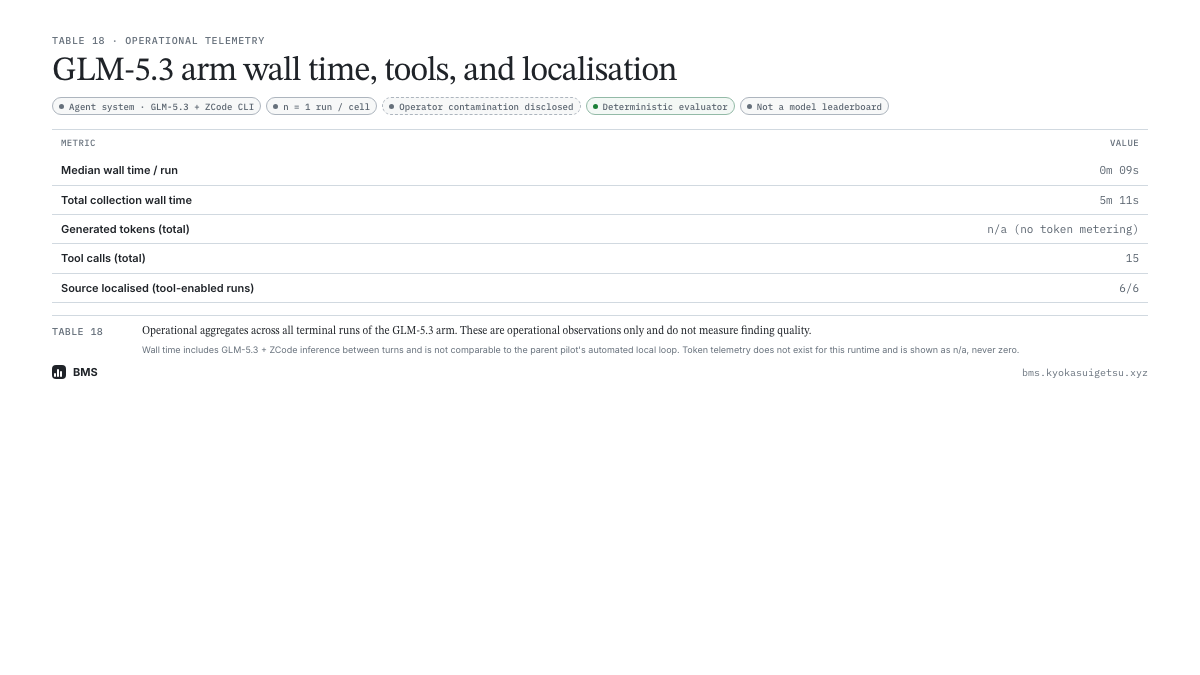
Table 18 · Operational telemetry
GLM-5.3 arm wall time, tools, and localisation
| Metric | Value |
|---|---|
| Median wall time / run | 0m 09s |
| Total collection wall time | 5m 11s |
| Generated tokens (total) | n/a (no token metering) |
| Tool calls (total) | 15 |
| Source localised (tool-enabled runs) | 6/6 |
Wall time includes GLM-5.3 + ZCode inference between turns and is not comparable to the parent pilot's automated local loop. Token telemetry does not exist for this runtime and is shown as n/a, never zero.
What this arm does not claim
Three textbook fixtures with n = 1 per cell set a ceiling observation on easy, familiar tasks — not evidence of audit-level skill on real repositories. The bootstrap interval is degenerate at 9/9 and supports no inferential statement. Cloud inference without seed control means the agent side is not exactly reproducible; only the harness, fixtures, evaluator, and analysis are. No model ranking — not over Qwen, and not over the Grok/GPT campaign systems — is implied by any number on this page.